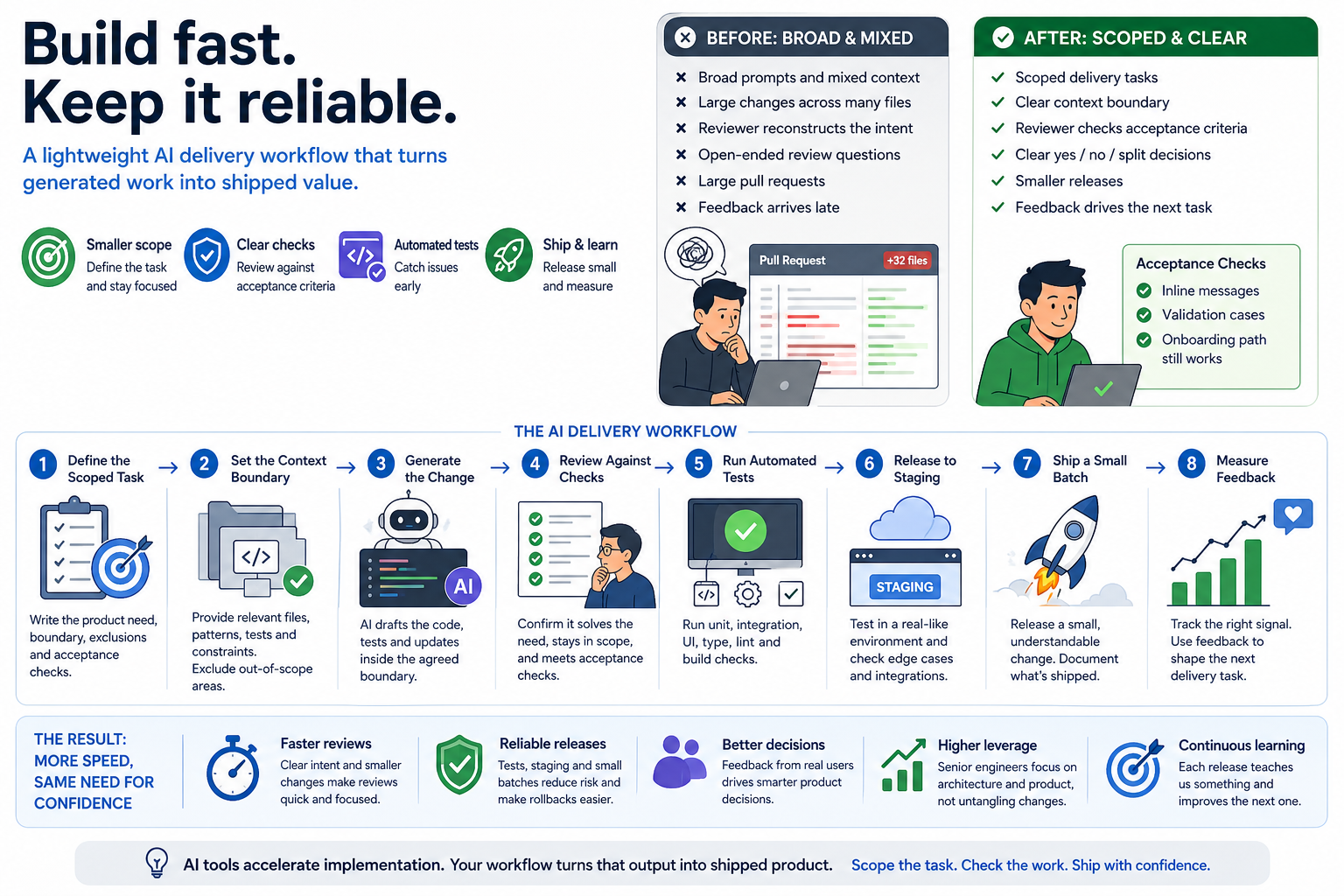
A Lightweight AI Delivery Path For Small Teams Shipping Real Product
AI A Lightweight AI Delivery Path For Small Teams Shipping Real Product Adam Sinnott 28 April, 2026 AI coding...


Adam Sinnott
23 April, 2026
Early traction creates a useful kind of pressure.
You have enough evidence to know the idea matters. You also have enough usage, demos, or pilot activity to see where the current build stops being enough.
This is the point where teams often ask the wrong question. They ask whether the product is “good enough” to keep going.
A better question is simpler: what has this build actually proved, and what does the next stage need it to do?
That distinction matters because a prototype, an MVP, and a production-ready product are different tools.
If you treat all three as the same thing, you either overspend too early or drag a demo further than it should go.
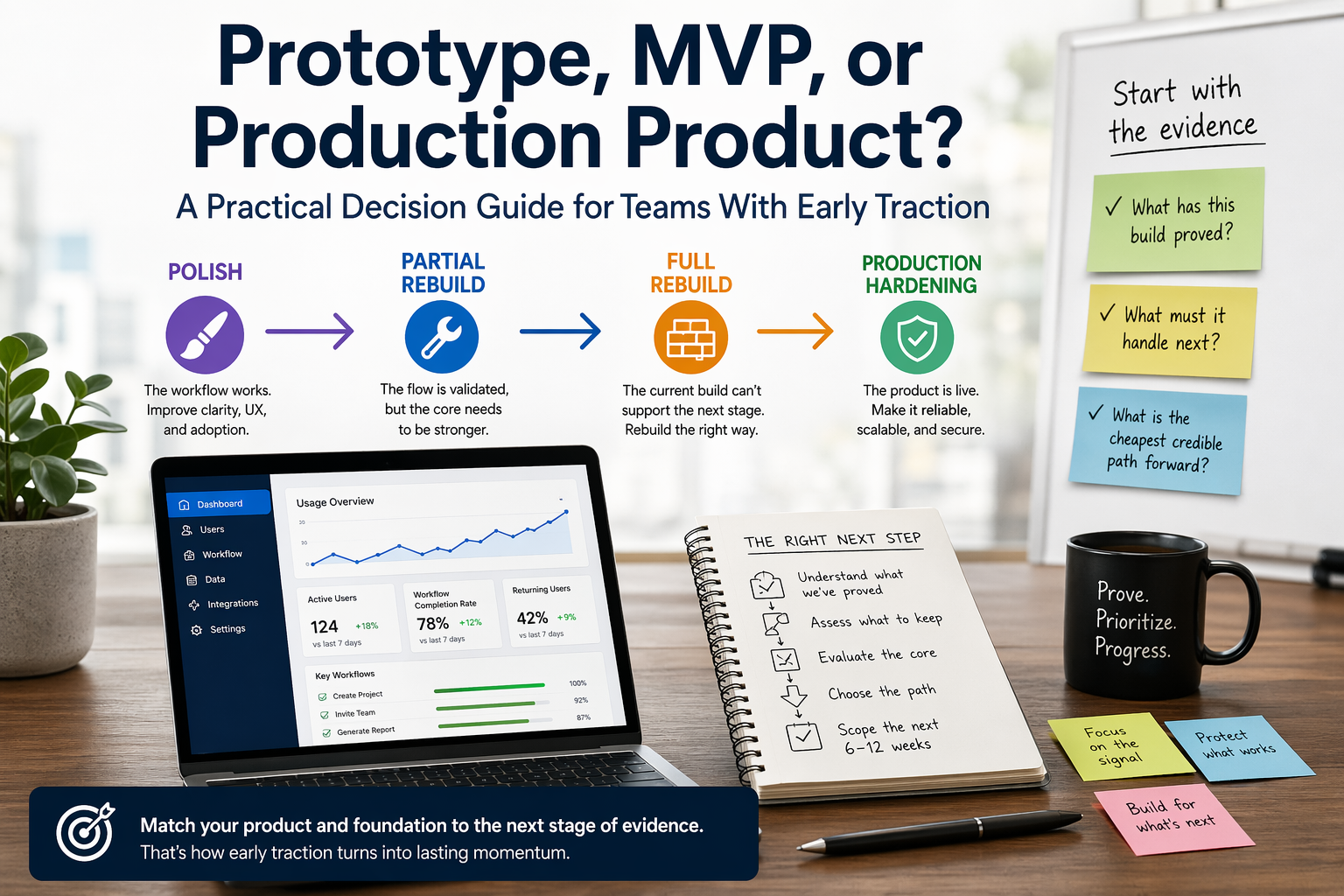
This guide gives you a practical way to decide whether your cheapest defensible next move is to polish the current build, rebuild part of it, rebuild it properly, or harden it for broader use.
Traction is only useful if you describe it precisely.
A lot of teams say, “the prototype is working,” when what they really mean is one of these:
Those are very different signals.
Before discussing architecture, list the evidence in plain English.
Your current build may already have proved:
Your current build may not yet have proved:
That split is the foundation of the decision.
If traction mainly proves demo credibility, you are still near prototype territory.
If traction proves one workflow is useful in live use, you may already have an MVP worth extending.
If traction proves the product is becoming part of day-to-day operations, you are moving into production hardening.
Most early products are uneven.
Some parts are already good enough to keep. Others only exist to support the current moment.
Start with the user-facing surface, not the codebase.
A useful rule: keep what already creates clarity, confidence, or repeat usage.
That often means:
In practice, teams often discover that the visible product surface is in better shape than the technical core.
A common delivery pattern is to keep most of the interface, keep the validated workflow, and rebuild the backend, data model, or integration layer underneath it.
That is usually faster and cheaper than throwing the whole product away.
Once a product starts serving real users, the core matters more than the demo.
You do not need enterprise-grade everything. You do need enough structure to support the next stage without slowing every release down.
Review these five areas.
Check whether the underlying data structure matches the product you are actually building now.
Good signs:
Warning signs:
A surprising number of early builds work well right up until more people need access.
Check:
If auth is still demo-grade, broader rollout usually means partial rebuild or hardening work.
If the product relies on third-party tools, internal systems, or manual intervention, inspect that honestly.
Check:
A product can look polished and still fail operationally because integration flows are fragile.
A useful product becomes harder to improve if every release feels risky or slow.
Check:
If shipping is still informal, hardening delivery may matter more than adding features.
You do not need huge process overhead. You do need a dependable way to catch obvious problems before and after release.
Check:
If your team is learning about production issues from customers first, the product is ahead of its delivery setup.
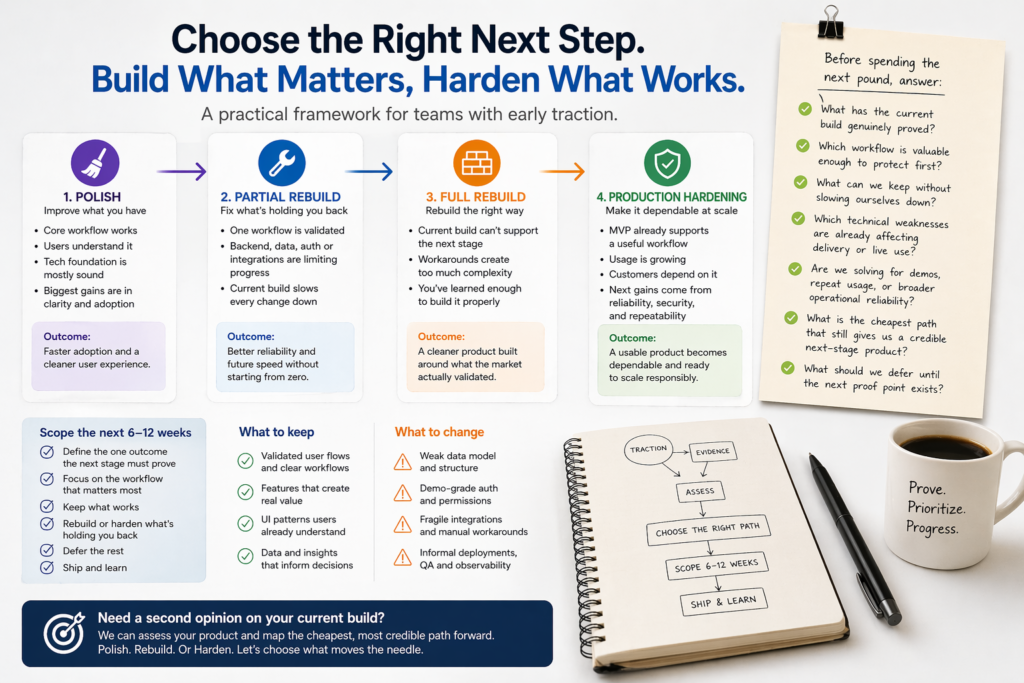
Once you have reviewed the product surface and the technical core, choose the path that matches the evidence.
| Path | Best when | Keep | Change | Typical outcome |
|---|---|---|---|---|
| Polish the current build | The core workflow works, users understand it, and the underlying structure is mostly sound | Most of the product | UX, onboarding, content, small technical fixes, minor feature gaps | Faster adoption and cleaner user experience without major rebuild work |
| Partial rebuild | The user-facing flow is validated, but the backend, data model, auth, or integrations are constraining progress | The validated workflow and often much of the UI | Core services, database structure, integrations, auth, deployment setup | Better reliability and future speed without restarting from zero |
| Full rebuild | The product proved demand or concept value, but the current build cannot sensibly support the next stage | Product insight, prioritised scope, sometimes design direction | Architecture, implementation, and delivery foundation | A cleaner product built around what the market actually validated |
| Production hardening | The MVP already serves a useful workflow and now needs to support more users, more usage, or stronger operational confidence | Product and architecture direction | QA, monitoring, permissions, infrastructure, performance, security, release process | A usable product becomes dependable and easier to scale responsibly |
This is often right for teams with a solid early MVP that needs better usability, stronger messaging, or a cleaner first-run experience.
This is a common post-traction path.
A typical example is keeping the front end users already understand while rebuilding the backend and deployment setup so the product can support live usage properly.
A full rebuild is easiest to justify when the old build gave you strong product learning, even if it is no longer the right foundation.
The mistake is not rebuilding. The mistake is rebuilding without carrying forward clear proof about what matters.
This is the right move for teams whose MVP already works for the core use case and now needs to behave like a dependable product.
Once the path is clear, turn it into a short stage plan.
The goal is not to write a giant roadmap. The goal is to define the smallest body of work that gets you to the next credible state.
For the next 6 to 12 weeks, define:
If you are polishing:
If you are partially rebuilding:
If you are fully rebuilding:
If you are hardening for production:
A short, stage-based plan keeps momentum intact.
It also stops the team from turning every new insight into more backlog before the current decision is complete.
Before committing budget, answer these clearly.
If the team cannot answer these in concrete terms, the next step is not more build. It is better scoping.
You do not need to rebuild everything because a prototype has limits.
You do not need to keep extending an early build just because it already exists.
You need a product shape and technical foundation that match the next stage of evidence.
That is what turns early traction into useful momentum.
If you have a prototype, rough MVP, or early live product and need to decide what comes next, we can help you assess it quickly.
In a short scoping session, we look at:
The output is a clear recommendation and a sensible 6 to 12 week next-stage plan.
AI A Lightweight AI Delivery Path For Small Teams Shipping Real Product Adam Sinnott 28 April, 2026 AI coding...
Uncategorized Prototype, MVP, or Production Product? A Practical Decision Guide for Teams With Early Traction Adam Sinnott 23 April,...
AI Small Studios, Big Capabilities: How Agentic Workflows Accelerate Software Delivery Adam Sinnott 15 April, 2026 Software development is...
Case Studies Smarter, Faster Information Retrieval: How AI-Powered RAG and CAG Can Streamline Your Business Tasks Adam Sinnott 28...
Droxford, Meon Valley, Hampshire
info@appcreators.co.uk
(+44) 01489 287009
AppCreators. All rights reserved.